
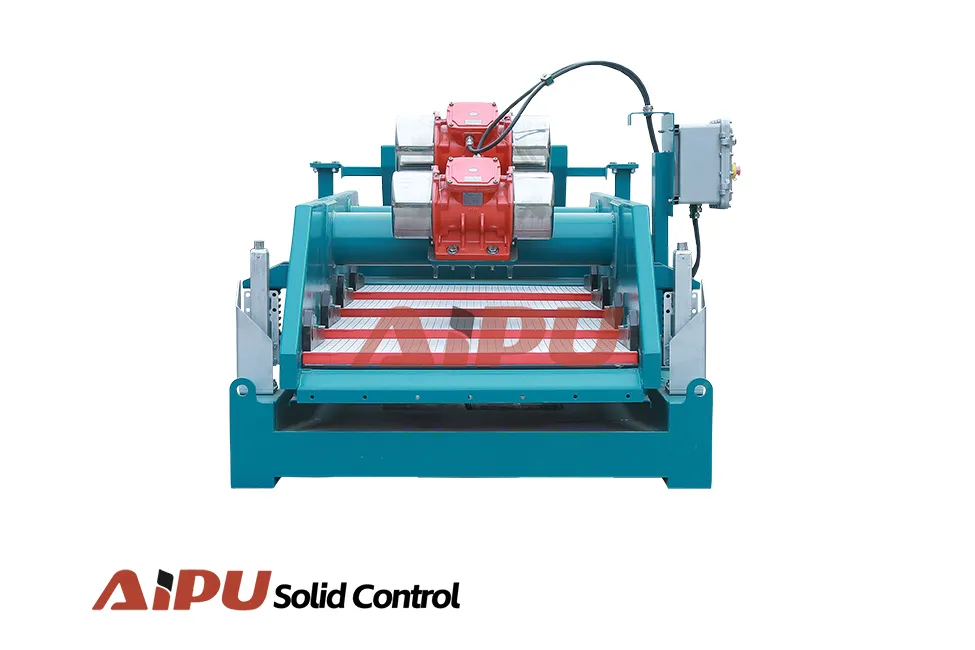
Introduction to shale shakers
As the primary and most critical solids control equipment on a drilling rig, the shale shaker is responsible for the initial separation of drilled cuttings from the drilling fluid (mud). Its efficient operation is paramount for maintaining mud properties, reducing downstream equipment load, and controlling overall drilling costs. Modern shale shaker technology has evolved significantly, focusing on higher throughput, finer screening, and enhanced reliability.
Technical Working Principle
A shale shaker utilizes high-frequency, linear or elliptical motion to convey drilled solids across a vibrating screen surface. As the fluid-solids mixture (the "returns") is deposited onto the screen, the vibrating action forces the liquid and fine particles (under the screen mesh size) through the screen, while larger cuttings are transported off the discharge end. The key is generating sufficient "G-force" to prevent screen blinding and ensure efficient solids conveyance.
Key Components and Specifications
Critical components define a shaker's capability. Understanding these specifications is essential for selection and operation.
- Vibrator Motors: Generate the screening motion. Common configurations are dual, triple, or quad motor designs, producing 4.5-7.5 G's of acceleration.
- Screen Panels: Fine-wire mesh panels, typically rated from API 20 to API 325 (microns). Composite, pre-tensioned screens are now standard for durability.
- Deck Configuration: Single, double, or triple decks in series for progressive, finer screening to maximize fluid recovery.
- Flow Capacity: Rated in gallons per minute (GPM); modern units can handle 1,200+ GPM of total flow.
Operational Benefits and Efficiency
Properly sized and operated shale shakers deliver direct economic and operational advantages.
- Mud Conservation: Efficient solids removal reduces costly mud losses and chemical additive requirements.
- Equipment Protection: Protects downstream hydrocyclones and centrifuges from excessive wear.
- Reduced Waste Volume: Drier discharged cuttings lower haul-away and disposal costs.
- Improved ROP: Cleaner mud enhances rate of penetration and overall drilling efficiency.
Industry Applications and Trends
Shale shakers are deployed on every land and offshore rig. Current trends focus on applications in challenging environments.
- High-Pressure, High-Temperature (HPHT) Wells: Utilizing robust seals and materials to handle aggressive fluids.
- Managed Pressure Drilling (MPD): Integrated systems that maintain a closed-loop fluid path.
- Automation: Integration with PLCs for remote monitoring of screen condition, flow rates, and vibration metrics.
- Increased Screen Life: Innovations in screen technology, such as 3D pyramid-shaped mesh, reduce plugging and increase service intervals.
Maintenance Considerations
Preventive maintenance is crucial for maximizing uptime and screening efficiency.
- Regularly inspect screen integrity for tears or blinding; replace as needed.
- Check vibrator motor mounts and bolts for tightness to prevent structural fatigue.
- Ensure spray bars for screen cleaning are functional and nozzles are not clogged.
- Monitor rubber deck seals and gaskets to prevent costly fluid bypass.
Conclusion
The shale shaker remains the workhorse of rig-site solids control. Its fundamental technology, centered on efficient vibrational screening, directly impacts drilling fluid performance and well economics. By selecting the appropriate shaker technology and adhering to rigorous operational and maintenance protocols, drilling engineers can significantly enhance solids removal efficiency, reduce non-productive time, and achieve substantial cost savings throughout the drilling program.